Thursday, February 20, 2014

Companions In A Desolate Place: Dogs & Their 'Jacks

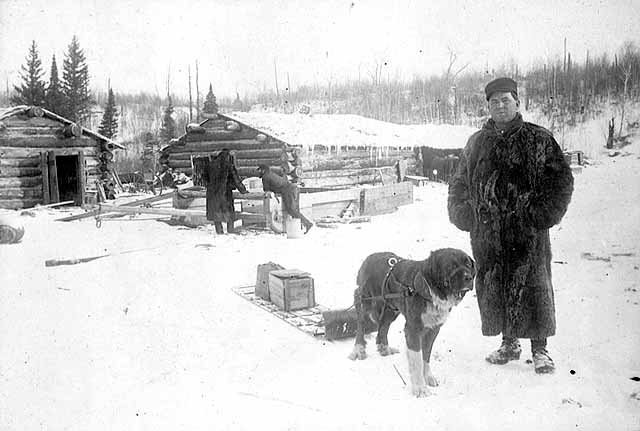
I bet the first animal that comes to your mind when you think of a lumberjack is a big blue ox, or maybe a horse. Yet, dogs were a constant companion for the lumberjacks -- often as a helper or the camp mascot. Sometimes a dog or an animal ceased being of this world, like the Hodag-- which has no relation to a dog outside of a claim that its name means horse dog. What follows will be mostly a look into the lives of dogs in lumber camps. However, like so much in the Northwoods, you can learn most of about the reality by examining the folk stories and songs that permeated throughout the camp.
An amazing caption from Explore Rhinelander
Most of the accessible stories show that dogs were mainly used for transportation on site. Joe Lefebvre's shares a story in Donald MacKay's The Lumberjack, about using a team of dogs to deliver 200 loads of wood, most likely cords, a quarter of a mile one winter. The dogs were beneficial because the lumberjacks were cutting in swamp in Quebec. Horses would sink. Dogs could make it through. Later Joe had an accident. It was the team of dogs that made the 70 mile dash to safety (Mackay, 293). 

In fact, it sounds like the use of dogsleds rose out of multiple strains of need. In the entry "Lumberjack Sky Pilots" on Mnopedia.org, Frank Higgins, a minister who would visit the camps, would in addition to saving souls would attempt to save lives and limbs. Frank would bring injured lumbermen into town. "After a particularly long and bumpy toboggan ride," Frank came up with using dogs "as a dog-drawn ambulance." 

Frank Higgins and his dog sled as found on http://www.mnopedia.org/multimedia/frank-higgins

Friday, February 14, 2014

President's Day at the Sawmill Museum

Photo Courtesy of the National Park Service
We are familiar with the presidential faces on Mount Rushmore, aren't we? George Washington, Thomas Jefferson, Theodore Roosevelt, and Abraham Lincoln peer down at us from their places carved in the side of the mountain. Did you know that these men also had experience with surveying?

A special President's Day event is taking place at the museum this Saturday, February 15, starting at 10 a.m. At that time, museum director Matt Parbs will be giving a presentation about presidential surveyors. Not only will he shed some light on the Mount Rushmore men's experience in the profession, but he will share information on over ten more presidents who also have experience in the field, including Andrew Jackson, Ulysses S. Grant, Dwight D. Eisenhower, and Ronald Reagan. The presentation will also showcase the field's changing position as a professional and recreational activity through the years.

Later in the day, children will have the opportunity to create a President's Day craft, beginning at 1 p.m. A repeat presentation will take place at 4 p.m.

We hope to see you at what will prove to be an interesting and informative presidential surveyor discussion!

Tuesday, February 4, 2014

Twice the Love for Valentine's Day and Love the Boy Scouts Day

February 8 will be a day full of love at The Sawmill Museum. With Valentine's Day nearing, participants will get the opportunity to create the perfect box to collect this year's valentine cards in. The day also brings us the birthday of the Boy Scouts of America. 2014 marks the 104th year of the Boy Scouts, a day we are commemorating with Love the Boy Scouts Day. You could say that we'll be feeling twice the love on February 8!

Speaking of love, isn't that what Valentine's Day is all about? The centuries-old holiday is celebrated in the name of St. Valentine by swapping cards, candies, and gifts, but who is St. Valentine? What is the history of this lovely holiday?

 One legend says that St. Valentine was a priest who, when the emperor of Rome in the 3rd century prohibited young men to marry in favor of them becoming soldiers, continued to marry young people in love in  secret. Another story has St. Valentine being killed for helping imprisoned Christians escape the Romans. A third legend says that Valentine himself was imprisoned and sent the first valentine card to a young girl with whom he'd fallen in love during her visits to his place of incarceration. Legend would have him sign his letter "from your Valentine," a phrase that has survived to be printed on the Valentine cards we send today.

This time of the year was celebrated by the Pagans as a festival called Lupercalia, which focused on fertility, and by Christians as St. Valentine's feast. It was at the end of the fifth century when Pope Gelasius declared February 14 as St. Valentine's Day. However, the association with love that defines the day for us now didn't come about until much later, and well into the Middle Ages.

The earliest known written Valentine dates to the year 1415, and was written by Charles, Duke of Orleans, during the Hundred Years' War. 

Today, Valentine's Day is celebrated in the United States, the United Kingdom, Canada, France, Mexico, and Australia. The Greeting Card association estimates that about 1 billion Valentines cards are sent each holiday.

With that much love being spread,  maybe we could extend some to the Boy Scouts of America!

Thursday, January 23, 2014

National Opposite Day... Or is It?

No, it's not Opposite Day, and no, we don't have any exciting National Opposite Day activities planned in order to celebrate it.

Don't plan to be at the museum on Saturday, January 25, from 1 p.m. to 3 p.m., because you won't be missing out on a wonderful Opposite Day celebration.

It's uncertain exactly when and with whom Opposite Day started, but we do know that we celebrate it January 25 every year. On this day, everything we say, do, see, and even hear, are total opposite of what those things mean on a normal day.

Opposite Day at the Sawmill Museum is gearing up to be lots of fun. The festivities will include an opposite scavenger hunt, and some opposite craft projects. Think we'll be able to keep it all straight?

If SpongeBob Squarepants can make it through a day of opposites, then so can we, so don't be there!

Six More Weeks of Winter?

What a winter we've had this year. With record low temperatures and heavy snowfall, I think we all are asking the same question. When is it going to be over?

February 2 will bring Groundhog Day to us, and possibly an answer to that question. The day has an interesting history, and is the theme of our event on Saturday, February 1, from 1 p.m. to 3 p.m., where participants will be able to make their own groundhog and terrain.

Groundhog Day was first observed as it is today in 1886. In the town of Punxutawney, Pennsylvania, a groundhog by the name of Punxutawney Phil will emerge from his home on Gobbler's Knob and take a look around, predicting the weather for the remainder of the winter. If Phil sees his shadow, then six more weeks of winter will follow. However, if Phil does not see his shadow, then it is predicted that spring will shortly follow.

The Groundhog Day tradition has roots in Pennsylvanian German customs, which date back to the 18th and 19th centuries and have origins in European weather lore. Groundhog Day also may have stemmed from Candlemas Day, an event observed by early European Christians. The custom was that clergymen blessed candles that were then distributed to the people. On the day that this happened, the weather was noted, and was used to predict the weather for the next few weeks. There are varying rhymes from different regions and countries that suggest what the weather meant, and included are English, Scottish, and German versions.

These days, Punxutawney Phil's appearance every year on February 2 draws tens of thousands of people to Punxutawney, PA and Gobbler's Knob to watch the little animal make his prediction. The Inner Circle, the group responsible for the care of Phil, recognizable by their top hats and tuxedos, plans the ceremony, which begins long before the sun rises at about 7:25 a.m. Based on past predictions and weather records, Phil's predictions have been correct 39 percent of the time.

Folklore suggests that since 1886, there has been only one groundhog that emerges from Gobbler's Knob every year, and that groundhog is Punxutawney Phil. According to the lore, it is a special groundhog elixir that he is given a sip of every summer that keeps Phil healthy and adds seven more years to his life.

When Phil is not at Gobbler's Knob predicting the weather, he lives in the town library with his 'wife' Phyllis.

Want to make your own Punxutawney Phil or Phyllis? On Saturday, February 1, at 1 p.m., you will have the opportunity to do so, and to create his or her own terrain. Join us to see if we get an early spring, or six more weeks of this winter weather.

Monday, January 20, 2014

Society for the Prevention of Calling Sleeping Car Porters "George"

Known simply as SPCSCPG, the man who created the Society for Prevention of Calling Sleeping Car Porters George called Clinton home. A George was behind this group, and this George was the key organizer behind two of Clinton's most enduring businesses, Eclipse Lumber Company and the Climax Engineering Company.

George Dulany established Eclipse Lumber in Minneapolis, but the firm had 22 lumber yards throughout America. To better manage the yards, George moved the headquarters to Clinton in 1910. He purchased the old Lamb Office Building, which sadly no longer stands.

While in Clinton, he is often credited for the creation of the Chamber of Commerce, getting the local Boy Scout troop started, and serving various other local organizations. His national claim to fame was the creation of SPCSCPG in perhaps 1914 or 1916. Eventually, the Society had Babe Ruth and King George as members, and at its height, 30,000 other members joned to advocate that the nickname for porters be changed from George to well anything.

Why would a George from Clinton, Iowa, England, and others care? Porters were almost always African-American. They were called George because George Pullman was their boss. A holdover from slavery, whites prescribed to African-Americans their master's, or in this case boss's, name. This didn't sit well with George Dulany.

Like so many whites in the turn of the century (like my boy William Faulkner), there was often an interesting relationship between blacks and whites. Whites, while not necessarily wanting the death of African-Americans, often operated from a very paternalistic position of power. George funded the Piney Woods Country Life School, a black boarding school in Mississippi, in "the memory of Aunt Lunky, a faithful mammy who served our family many years."

It is one thing to help educate those who served you. It's another to have to see them take your name. So whether out of amusement or true consternation, George Dulany founded the SPCSCPG. In 1959, the Clinton Herald described the SPCSCPG as one of his lighter side projects that was a "national fun organization." The Society was often featured in Time, Business Weekly, and other magazines. The Society sent out tens of thousands of membership cards to every George it could find.

While Dulany might have been having fun, it was real for the porters. The use of the name George robbed them of their identity. Having to be subjected to this harassment, tested their patience. George truly meant nigger. Whites realized quickly that the n word was charged. The use of the n-word would be too much for many whites. George though solved that. It solved it so much that George caught on in other professions. In fact, today the grunt workers at car dealerships are often called George.

Porters always fought and eventually gained a union and many rights like nametags.

The Racial and Class Riots of The Raftsmen

      Many raftsmen called Iowa and Illinois home, either permanently or just passing through. The American heritage often celebrates them through song and myth. Often they are viewed through the prism of the working class and a shared river experience.

           While it is easy to romanticize the raftsmen and river pigs, one should never forget that their antics were permanent and forever affected their contemporaries.


       Take for instance, a little note in the 1869 when 125 raftsmen boarded the Dubuque steamer in Davenport.  Simply: The raftsmen, riding the deck, tried to enter the area "roped" off for the cabin passengers. A "negro" guard blocked their entry, which caused the raftsmen to attack the guard and then the crew. All told, the raftsmen stabbed five African-Americans. The raftsmen commandeered the boat and headed north. The ship captain notified the sheriff of Rock Island about the vigilantes, and the sheriff formed a large "army" to save the ship. Actually on the shores of Clinton, the sheriff and his army took control of the ship, and 42 raftsmen were jailed. The other 80 or so, on their best behavior, supposedly spent the night in the town.